Tuesday, June 4, 2013

Chipper Jones could hit!

Upon Chipper Jones' retirement Elias Sports Bureau brought us this gem of a list. These five players are the only ones to accumulate a .300/.400/.500 slash line with 500 doubles, 450 Home Runs & 1500 walks.

I love the inference that Chipper Jones belongs in this group of players. As you can see the
slash line had to be dramatically lowered to accommodate Chipper's inclusion. This is not to say Chipper isn't a Hall of Famer in his own right but we are talking about players whom are at the extreme elite hitter level. The average slash of these four players are .339/.455/.628 over a career
that spans 20 seasons!

In Chipper's defense he played in an era with an international talent pool with specialized pitcher's throwing in the mid-90s.


I love the 1994 Ultra set design but when it came to the horizontal cards they really screwed up by not putting the player's name across the bottom. A very lazy artistic choice. With the strike looming and then taking place during 1994, baseball cards became a secondary thought. 1994 marks the end of the high water mark in baseball cards. With the pack prices inflated and literally hundreds of products to chose from the market crushed under its own weight.


Wednesday, January 30, 2013

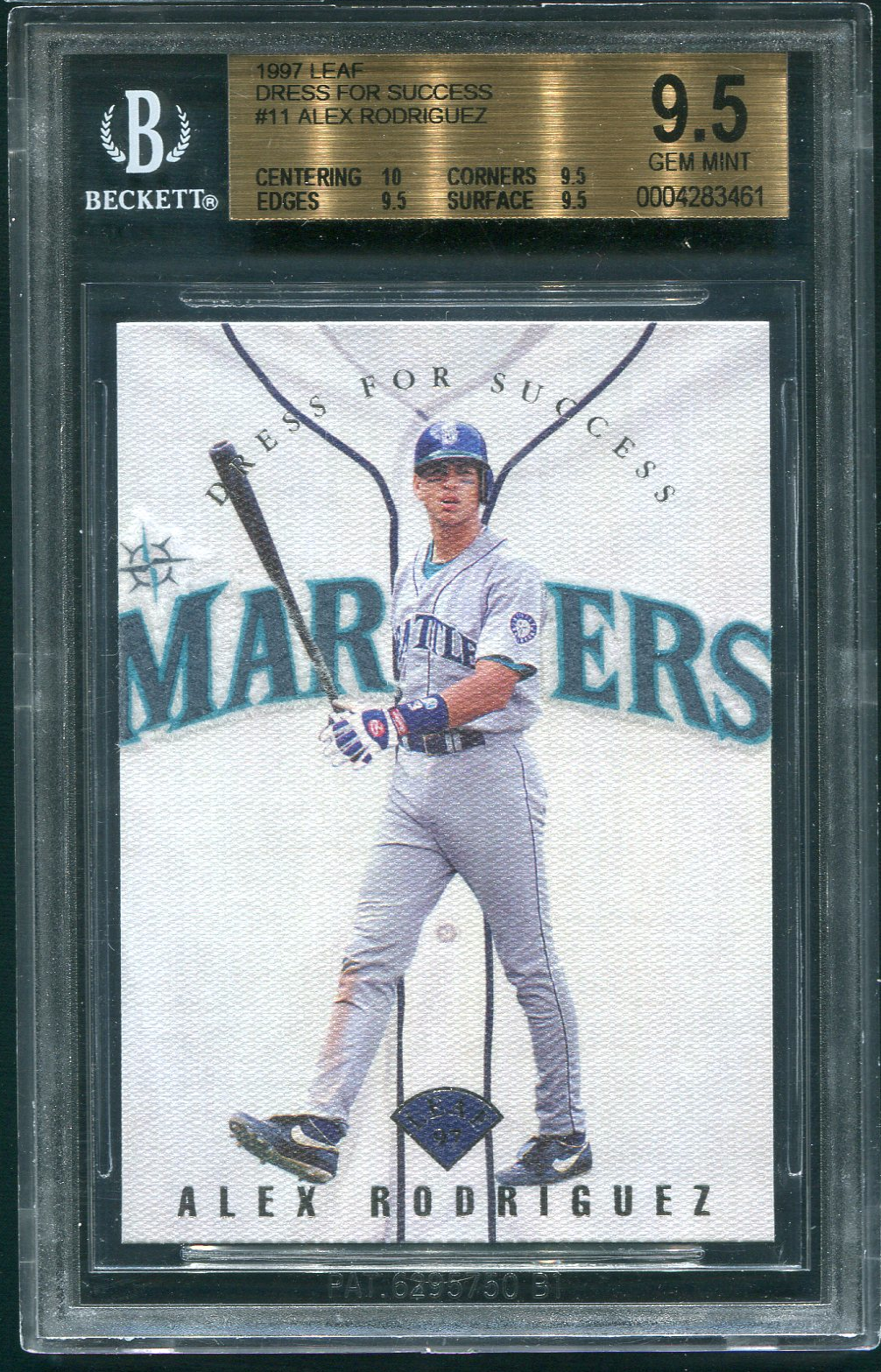
1997 Leaf. Drugs for Suckcess


TodayMLB kept reminding everyone that they have the toughest drug policy in North America. However, tabloid journalists brought the latest debacle to us - not failed drug tests. Perhaps these new events will have MLB institute lifetime bans for offenders. Would baseball suffer if Alex Rodriguez, Nelson Cruz and Gio Gonzalez were no longer playing?

Anyhow, Leaf in 1997 decided to make a gimmick card out of Nylon material. A little known fact - Nylon is not a chemical name for the material made. It is a compound name made up of the corporate offices of DuPont, which were located in New York and London.

Dress for Success was an 18-card insert set of the who’s who of baseball. Actually Leaf went out on a limb with card #14 Brian Jordan. Each card was serial numbered to 3500. I don’t know how many came pre Series 1 box but I’d guess 2 per box. The cards have a nice feel to them. By the late 1990s there were literally hundreds of insert sets and these cool cards lost in the shuffle.


Friday, January 25, 2013

To Peel or Not to Peel


Starting with 1995 Finest, Topps decided to put a protective coating sticker over the front surface of the card. What reason you ask? For no reason I answer. The Ultra Violet coating that had been applied to premium cards when not fully dried had tended to make the card stick together. Instead of drying the cards properly Topps decided to apply a sticker.

Now the purist will tell you that the sticker is now part of the card but the practical collector will tell you that the sticker is nothing more than part of the pack – an individual wrapper.

When it comes to grading it is best to remove the sticker because BGS and PSA will consider the sticker part of the surface. The problem with that is that the stickers then to be filled with minor air bubbles.

The other reason to remove is in terms of value. The (eBay) market has not put any premium on cards with peel intact.

About The Card

This 1995 Finest Cal Ripken is the same card with the peel and without. I will be subbing this in the future. It appears to be in Gem Mint Condition.

Tuesday, January 15, 2013

But there is no joy in Mudville.


Written plainly in Exodus 23:2 it states, “You must not follow a crowd in wrongdoing.”

By all accounts Barry Bonds stayed away from performance-enhancing drug usage until 1999. He followed lockstep with the rest of the juiced crowd and threw away his reputation and legacy by destroying the record book for wads and wads of cash.

I was fortunate to have followed Donnie Baseball in his prime daily.
And Barry Bonds was still the best player I ever watched play the game.

When I look back on Bonds there is nothing that you can point to that makes you happy anymore.
Mattingly on the other hand has his stature intact.

When McGwire and Sosa where chasing Maris I remember people telling me “Thank God it’s not Bonds.” 
That's because his lifelong mercurial angry black man persona made it impossible to root for him outside of Pittsburgh and San Francisco.

At the time, Bonds was still playing the game on his natural ability, which were still light years ahead of everyone not named Junior Griffey
But even Griffey didn’t take his plate appearances as deadly serious as Bonds. Bonds had the superior baseball intellect along with the superior talent base.

In 2004, Barry Bonds was walked 232 times. Officially he was intentionally walked 120 timesand with guys pitching to him carefully he still managed to hit .362 with 45 home runs.
Even if an extremely conservative 25% of the league was using PEDs no one comes close to Bonds accomplishments.

It can't possibly be all attributed to a drug but that is the narrative history will repeat, as it should be.

Poor Barry Bonds. He followed the wrong crowd.

About the Card.
In the entire Barry Bonds baseball collection this one stands because he allowed himself to be photographed. Others have described that scenario as pulling teeth. I love the photo but I don't understand the composition. Why did topps leave some much negative space above his head?

Wednesday, January 9, 2013

The Hall of Fame. Preserving Revisionist History.


Well I guess I wasn't watching legendary players the past twenty years. When Mark McGwire revealed his usage of androstenedione he had already hit 53 home runs. For a quick refresher andro was banned by the NFL, NCAA and the IOC but was allowed by MLB. At this point all the suspicions were confirmed - Mark McGwire was a steroid user. But did anyone care? He went on to blast 17 more home runs to put America into a baseball frenzy. He wasn't breaking any rules so everyone enjoyed the spectacular displays of absolute freakish hitting. It wasn't until six years later when Jose Canseco pulled back the curtain to reveal his own self as 'The Great and Powerful Wizard of Steroids' that people decided that the ride wasn't all that fun because we've been duped! But where is the same outrage concerning the corrupt political and financial systems? With that being said the Hall of Fame has lost its sense of humor today. Isn't this the same museum that houses Phil Rizzuto? The Hall of Fame is a museum dedicated to...a game. It's not a place of judgment. Steroids warped the record books but not the wins and losses. Babe Ruth warped the record books just as much by refusing to play against the very best black ball players. So today we discovered there is a group of men who write about baseball for a living that have decided to right a wrong by trying to cover up their own error of not taking a stand against these drugs in the first place. 


Here is a link to a sports illustrated article by Tom Verducci. It's the absolute epitome of turning a blind eye to steroid use. It directly celebrates it and shows it being the cause of the greatness. Mr. Verducci never once mentions there is something odd about these circumstances. It comes complete with the classic and laughable cover up of "protein shakes".

Saturday, September 15, 2012

Hank & Beer Barrel Man

1976 Topps #550 is Hank Aaron’s last base card from his playing days. Hank made it known he was retiring so Topps didn't make him a base card in 1977. Topps wanted to be topical more than a year in review but Hank should have had a tribute card in 1977.

Beer Barrel Man was the first logo used by the Milwaukee Brewers. Originally used by the defunct Brewers minor league team. This gem was brought back by Bud Selig when he purchased the Seattle Pilots and moved the team into Milwaukee. 

This slab sold for $192.60 on an eBay auction. I'm assuming the person is going to crack it out & sub it to PSA but chances are this card was already housed in a PSA 9 slab hoping to get 9.5 from BGS. 

About the card
A very simple design that incorporated one aspect of the teams color. It also featured a sketch of a player representing the position. This idea was borrowed from the 1973 set.

A great improvement to this set would have been to use another photo instead of the drawing and the team Wordmark logo.

Wednesday, March 7, 2012

1986 Sportflics & Steve Carlton: Briefing for a Descent into Hell.

In Ball Four, Jim Bouton wrote, “You spend a good piece of your life gripping a baseball and in the end it turns out that it was the other way around all the time."

This observation made in 1970 was clearly on display in 1986.
At the age of 41, Steve Carlton refused to hang them up and began the most disastrous endings to a legendary career.

It truly was a descent into sports hell.

On June 24th, 1986 the Phillies unconditionally released Steve Carlton after first asking him to retire. He refused. He felt he could still pitch. This despite the fact that he was getting rocked off the mound every start.

On July 4th, 1986 the Giants signed Carlton. The reason the Giants signed him was because Steve, while getting rocked by the rest of the NL, somehow dominated the Giants.
Versus Giants 15.1 innings, 12 hits, no walks, 12 strike outs and a 1.19 era. In his other 14 starts: 68 innings, 90 hits, 45 walks, 50 strikeouts 5.05 era. Ouch.

So the Giants actually thought he had gas left in the tank.

The first thing Carlton does is break his 8- year ban on giving interviews. Right off the bat the Giants should have realized that not having Silent Steve wasn’t a good sign.
He stated the he was mechanically sound and his arm wasn’t sore. The Giants believed this lie because somehow he dominated them. But then again that what happens when your line up showcases Chris Brown as your three hole hitter and even more telling was that Chris Brown hit a home run off Carlton in the second game. Talk about a red flag.

So what we got is a talking and delusional Steve Carlton pitching for the Giants and he promptly stinks up Candlestick.

On August 5th, 1986 vs. the Cincinnati Reds Carlton strikes out Eric Davis for his 4,000th career strike out.

After the game Steve Carlton announced his retirement.

5 days later Steve signed with the Chicago White Sox. Surely he could fool those AL hitters who never saw him. Sure enough he threw six quality starts in his last ten starts of the year.

As I said before this was just the start of the decent into hell. 

About The Card
I happen to think that 1986 Sportflics is the best set produced for the year. But it was also the most expensive and even if you bought an entire box you'd only end up with half the set. That's if the coloration was good which it isn't - it's really bad which made things much worse. It didn't feature Jose Canseco,Wally Joyner or Cory Snyder which gave you no reason to spend the extra money. But as a card it was different in a good way. It wasn't cardboard and it had great bios on the back.
It was the first card pack to use tamper proof tin foil.

Thursday, February 23, 2012

BGS Multipliers. Gem Mint versus Pristine. What’s the jump in value?

The inevitable question when collecting anything particularly baseball cards is “How much are they worth?” Now without going into economic theories and methods let’s just look at realized prices albeit a very small sample size.

This is hard to track because rarely is there a GEM MINT 9.5 & PRISTINE 10 copy listed at same time to compare. The other problem is the aforementioned sample size. It’s too small to make a true judgment. However it could be said that this works in favor of the perceived scarcity of the item. But let’s work with what I have.

Now in my estimation the upgrade in quality from a Gem Mint 9.5 to a Pristine 10 isn’t as big from a Mint 9 to a Gem Mint 9.5. But nevertheless it’s still noticeable.

Again it’s worth repeating that this is just a couple of slabs selling during a certain winter. This is by no means a gauge that can be set in stone. 

Rod Carew 1982 Fleer #455 BGS 9.5 sells at auction for $8.74 – That’s the very definition of a steal in a buyer’s market. That’s basically the cost of grading to own a gem mint copy of one of the great quirky cards of the 1980s. In case you didn’t know 1982 Topps has used the same photo for their “In Action” subset.

Rod Carew 1982 Fleer #455 BGS 10 sold at auction for $36.19! Whoa that’s just 4.2 times as much. In context that's another steal!

Mark McGwire 1987 Donruss #45 BGS 9.5 sells at auction for $16.00. For one of the great-overproduced sets this is still a solid price in 2012.

Is it worth it to run out and grade 10 copies? Perhaps not but what if you landed a pristine…

Mark McGwire 1987 Donruss #45 BGS 10 sold at auction for  $229.79! Wow that’s a multiplier of 14.4! The steroid junkie superstar still has major hobby pop. Now of course this same card would have gotten $2000 in 1999 but $229.79 is tremendous value for a card that readily available raw at less than a buck.

Don Mattingly 1984 Topps #8 BGS 9.5 sold at auction for $86.85
Another over produced set holding tremendous value. Donnie Baseball is the man responsible for fueling the baseball card boom of the mid 1980s. His three rookie cards are still in demand especially in high-grade condition.

Don Mattingly 1984 Topps #8 BGS 10 sells at auction for $512.34!
That’s a 5.9 times a much. That’s a serious jump.

Barry Larkin 1987 Topps #648 BGS 9.5 sold at auction for $34.33
One thing you have to say about this over produced sets is that they are still popular. $34.33
is tremendous value for a readily available card

Barry Larkin 1987 Topps #648 BGS 10 sold at auction for $141.48
That's a multiplier of 4.1 - right in line with what you'd expect.

It’s silly to extrapolate any information but we can see that Pristine slabs get anywhere between 4.1 and 14.4 times as much as their Gem Mint counterpart.

About The Card
The 1982 Fleer set was as simple design and as time has passed it looks more cheap than it did then. But this is before Fleer is taking the business of selling cards seriously. The cards at this point were just a delivery system for their team stickers. You can say with conviction that zero effort went into making these cards. Fleer just trying to grab a piece of the market pie.


Thursday, February 16, 2012

Cat on a tin roof, dogs in a pile. Nothing left to do but smile, smile, smile.

In a moment, in the twinkling of an eye, at the last trump: for the trumpet shall sound, and the dead shall be raised incorruptible, and we shall be changed.


1st Corinthians 15:52


Monday, February 6, 2012

Crackin' Wax with Crackin' Wax


This is the first in a series of interviews where we delve into what makes the hobby turn…The Collectors

Christopher Lawson writes at Crackin Wax. http://crackinwax.wordpress.com
The great thing about his posts is his detailed examination of card designs.

So I asked him what is his favorite set?

I will always have a place in my cardboard heart for 1986 Topps Baseball. The first pack of cards my mom bought for me was from that set. I remember the ride home in the backseat, cracking open my first wax pack. The first card that I pulled was of my all-time favorite baseball player, Kirby Puckett. Being a trading card designer, the aesthetics of this set go against all of my training and beliefs. It’s quite possibly one of the least visually appealing professional trading card sets ever produced.”


FirstBallot: I have to agree with you. A quarter length black border highlighting bulky and awkward team lettering was a disaster. Nothing about it says baseball. Not to mention they missed out on over a dozen prospects.

“On the other hand, my creative intuition always feels justified when looking at the brilliant 1991 installation of Topps. From the simple and effective inner double-frame border to the clean readability of the text, and from the excellent use of team logos to the amazing photography, there is very little to dislike about this set.”


FirstBallot: I’ve written about this set before. For the most part I agree with your assessment and it’s most likely the best flagship set of the year but it doesn’t hold a proverbial candle next to its premium counterpart, the landmark 1991 Stadium Club set.


As enamored as I was with the 1991 Topps flagship set, the debut of Stadium Club was pretty exciting, especially for a teenager with his own hard-earned income. The price tag it carried on its packs suggested the cards within were something special, and at first rip they were. At the time, it seemed clear that they were an answer to Upper Deck's base cards. It was a thrill to crack my first few packs. All of that gloss, the full-color backs and the crisp full-bleed photos on the front seemed so different and fresh. While the '91 flagship set was the cute girl next door, Stadium Club was the hot cheerleader from the suburbs--nice to look at, but too expensive for my tastes. Hindsight being 20/20, it seems a bit more obvious that Stadium Club was an important step in Topps' market diversification. Topps was able to open a new door to reclaim collectors that had grown beyond the old pieces of cardboard stuck in the spokes of their sons' bicycles. The 1991 Stadium Club set would eventually give relevance to the words "high-end" in the trading card hobby. Had Stadium Club failed in 1991, the hobby may never have seen the advent of on-card autographs, embedded game-worn uniform swatches, and authentic vintage bat knob cards. Without high-end products, I feel that the trading card hobby may have folded completely by the turn of the century. In that sense, I feel that Stadium Club was an effective and important catalyst to the hobby as we know it today.

Firstballot: It really did recapture people's imaginations about collecting cards again. At the time, I remember people wanting these cards ahead of Frank Thomas' & Griffey Jr's real rookie cards.


How do you feel that Topps owns a monopoly on baseball card making? Competition helps drive innovation and quality of work. Competition gives the target market more options and helps further spread their dollars. Without competition, perhaps Topps would have never felt the need to produce Stadium Club in 1991. Without Stadium Club, perhaps no trading card company would have ventured into the high-end market. Without the high-end market, perhaps the trading card industry would have completely folded. It's hard to say. What is certain, however, is, monopoly or not, Topps will likely remain the most recognized MLB trading card brand.

FirstBallot: Amen

Sunday, February 5, 2012

Black Refractor History Month


These two men set out to make things right. And they succeeded. And although both didn’t live long enough to see the magnitude of their work that ended up moving mountains - these men are now mountains of humanity themselves. First Ballot pays tribute to Dr. Martin Luther King and Jackie Robinson in Black Refractor History Month. And frankly, for everyone who is for oppression of any kind – you can all go fuck yourselves.

The refractor first made its appearance in the debut of the landmark set 1993 Finest. The cards were not denoted in any way other than they looked like a disco ball reflecting light.

Well a lot happened in between that moment and when Topps unveiled the black refractor but lets just focus on the black refractor!

In 1996, Topps debuted Topps Chrome. Another instrumental moment in marketing gone awry but let’s fast-forward to 2002. Topps decided it’s time for a black version of the chrome because, why not?


Here is an example of the 2006 Topps Chrome Black Refractor. As far as I’m concerned it’s just an exercise in redundancy. 


2006 Randy Johnson – Bad, very bad. From April 29 -  May 24 in a span of 6 starts here are the numbers. Children please turn away now. 31.2 IP, 43 hits, 28 earned runs, 13 walks, 24 ks, 7 HR allowed, 8.07 era

Record? 3 -2. Of course, in the 3 wins the Yankees had to score 17, 10 & 8 to win. 

Thursday, February 2, 2012

1961 Topps Bob Gibson. Time Out of Mind.

May 21, 1961 Cardinals at Cubs Bob Gibson set a career high with 11 strikeouts. He threw a complete game shutout, the second of his career, allowing just 4 hits & 4 walks.

The Cubs featured four future Hall of Famers in the line up batting fourth through sixth was Ernie Banks, Ron Santo, and Billy Williams & pinch hitting for Al Hiest was Richie Ashburn. The four combined accounted for three of the four hits and three of the four walks. Billy Williams got the only extra base hit.

In the bottom of the sixth with the game tied at 0 and two outs, and Richie Ashburn on 3rd, Gibson intentionally walks Ernie Banks to face Ron Santo, whom strikes out looking.

It was an eventful game for Gibson who scored the tie breaking run and then tacked on a insurance run with an RBI double. He was also hit by a pitch.

In Gibby's final start of 1961, he again threw a complete game shutout this time versus the Phillies which served as a harbinger for the rest of his career.


About the card.
1961 Topps is really nice basic design. I wish the team name was bigger but other than that it tells you what you need to know. This particular slab sold for $420.78 on eBay on January 31st by prewarcardcollector whom have some really beautiful high grade cards. Truly remarkable that the card was found in this condition and now that it's in a slab we can be assured it will stay that way.

Monday, January 30, 2012

2012 Tigers - If the thunder don't get you then the lightning will.

Elias Sports Bureau brings us this gem of a stat. "The Tigers are the second team ever to field two players under 30 years old with 200 career home runs. The other was the 1961 Milwaukee Braves, with Hank Aaron and Eddie Mathews." The Braves also featured legendary ace Warren Spahn and revising that role is Justin Verlander for the Tigers. 


In 1961, Hank lead the league in Total Bases and Eddie lead the league in walks. Warren lead the league in Wins, ERA, CG, Shutouts and WHIP and finished SECOND in Cy Young...wait what?


Anyhow, before I investigate that award voting it's a safe bet to think Miguel, Prince & Justin could replicate those accomplishments. And there is no reason to think that these three won't also make there way to Cooperstown. They all have the eye of the tiger.


About The Cards
On this blog I haven't delved into the history of Chrome or Refractor cards but I loved both concepts when they first appeared but have since become annoyingly over done.


In a future post we will examine both trends and what they've meant to the hobby.


Sunday, January 29, 2012

1982 Topps Traded: A Change of Scenery

1982 Topps Traded is primarily known for the Cal Ripken, Jr. card. But why was Cal in this set anyhow? He was already in the 1982 Regular Issue and he wasn't traded. Cal was considered a "promising rookie" so why not double down a card for him.

Ozzie Smith on the other hand was traded. A change of scenery and managers landed him in Cooperstown. That smile on Ozzie's face is legitimate. Ozzie had been in contract dispute with San Diego since he signed. The problem reached absurd heights when his agent, Ed Gottlieb, placed an ad in the San Diego Union, it read "Padre Baseball Player wants part-time employment to supplement income. College education, willing to work, prefer PR-type employment. Needs hours tailored to baseball schedule, but would quit baseball for right opportunity."

The truly disturbing part is that apparently Ozzie had blown most his money and his wanting a raise had nothing to do feeling underpaid. [1]

Anyway you look at it, he wasn't getting a raise. And regardless of his out of the world defense the way he hit he didn't deserve a raise. Ozzie Smith was the leadoff hitter for the Padres leading the league in plate appearances with a .294 OBA. The reason I think manager Frank Howard never noticed Ozzie was an out machine is because the entire team couldn't hit. Regardless, once Ozzie got to St. Louis he improved his hitting enough that you could live with it.

In 1982, major league baseball had two other Hall of Fame shortstops playing who could rake and play defense. Robin Yount in Milwaukee & the aforementioned Cal Ripken. The very next year all three would be playing in the All-Star game.

About the Card
1982 Topps borrows a lot of its design style from Activision, an at the time, wildly popular video game maker. I like the design but it does resemble a hockey stick a little too much for my liking.
Notes
[1] Scorecard, Sports Illustrated, Kirshenbaum, Jerry, May 5, 1980

Thursday, January 19, 2012

1981 Topps The Wonderful Wizard of Oz


In 1981, on the back of the position player cards, Topps introduced three statistical categories - Slugging Percentage (SLG), Walks (BB), and Strikeouts (SO). 1981 also saw the return of Stolen Bases (SB) which has been absent since 1971.
For Ozzie Smith, the stolen bases and walks helped him look a little more valuable at the plate but oh goodness look at that slugging .276! Yikes that's awful. 
Although his reputation as a defensive 'wizard' is well entrenched Topps continued to show Ozzie batting or posing every season except the lone exception of 1987 Topps where he looks to be camped under a harmless pop up.


Tuesday, December 20, 2011

1978 Topps - Steady

Eddie Murray falls into my category of under appreciated superstars. He was only one of eight men to play 3,000 or more games. The other seven are legendary players but Eddie is hardly mentioned with the likes of Cobb, Aaron, Rose, Musial, Henderson, Yastrzemski & his teammate for seven seasons Cal Ripken. Truly remarkable accomplishment.

He was so under appreciated that he should have been on the 1977 Topps Rookie Infielders #477 card but the slugger lost out that assignment to slap hitting scrub Orlando Gonzalez.

This oversight left him with his own rookie card for 1978. Which is a rarity unto itself for the era.

In another moment of being under appreciated - even though he won the AL Rookie of The Year he had to make the Topps All-Star Rookie cup at DH (the first and only time that has happened) because Doug Ault beat him out at first base.

Eddie was primarily a DH in 1977 because Lee May took more games at first but in essence it was a 1B/DH platoon between the two & the both produced.

1978 Topps is a simple design. Classic white borders with pennant script for the team name. The design has you focus on the photograph and steps out of the way.

Pictured is a BVG 9 'mint' example. Very strong centering. It's at auction right now with a starting bid a $275. It's certainly worth that but I doubt it was get any bids with that starting point.
If this was a .99 cent auction I think you could fetch $330 with most bidders looking to cross it over to a PSA 10.

One of my crazy hobby side projects is to obtain a PSA 9 or BVG 9 or better copies of this set.
This would be the most expensive card in terms of book value but when you get into PSA registry wars - prices for even the likes of Doug Ault can be outrageous.

Editor's Note
As predicted the card did not sell at an opening bid of $275 - It has been re listed with starting bid of $225. I'll predict once again that this opening bid will garner no action whatsoever.

Friday, December 9, 2011

Ron Santo: "This Is My Hall of Fame!"

Ron Santo is now a Hall of Fame player. I've never seen him play but I always knew the name. In that regard he is famous but just looking at the stats this is a dubious distinction bestowed upon a very solid ball player. What's wrong with being just a solid ball player? Perennial All-Star? Perennial MVP Candidate? Wasn't that part of his job - to produce? Why couldn't people be content with Ron having his uniform number retired? 


Well, the Hall of Fame is a business and they constantly need two things to happen. They need players and they need controversial issues. Otherwise, why would you be discussing one person's merits over another. However, the Ron Santo enshrinement is bad timing. First of all, during his entire life he was denied induction, rightfully so, by the writer's AND the veterans committee! Now, in comes a third vote process the Golden Era Committee and kaboom - instant Hall of Famer.


How horrible to think that Ron Santo's best career move was to die? How misguided that this group of 16 voters think that somehow Ron will get wind of this information? It's more insulting than honoring. 


But the greater problem it develops, is that it gives hope to players, that they too, may get a key to the kingdom from the Golden Era Committee somewhere down the line.  


According to Bill James' HOF test where a likely HOF scores 100/50. Ron Santo waltzes in with 88/41. Is that the worse election ever? No, it's not, but it's without a doubt lowering the bar....again. 


Let me put this another way. If you added the 15 votes he got from the Golden Era Committee members to the 1998 Ballot the year Ron got his most votes he still would have fell 136 votes short of election. 


Here at First Ballot we accept the reality that he is in and we will now rectify the "HOF Class of 1980" to reflect that's when Ron Santo got in along side Al Kaline & Orlando Cepeda. 


About the Card
I'm not a fan of this design. Never have been. It hasn't held up over time.


Saturday, October 29, 2011

1987 Fleer - They Did The Right Thing.

Spike Lee’s must –see seminal classic on urban society “Do The Right Thing” (1989) features a scene, in which, Dwight Gooden and Roger Clemens are being discussed in terms of which pitcher is better. 

About the Card

Dwight Gooden and Roger Clemens were on the fast track to the hall of fame. Unfortunately, Gooden was drivin’ that train high on cocaine and he derailed for good in 1994. Clemens had his own drug addiction to steroids. But in 1987, these guys were the premium pitchers in their respective leagues playing in the largest markets on winning teams.

They met for the first time in the 1986 All-Star Game. Fleer recognized an organic moment to make an additional card for both players. It worked really well. 1987 Fleer is known for it’s sky blue background. Never has been this color been so prominently used before. However, you'd think they get a shot of them without people in the background messing up the composition. 

Thursday, October 27, 2011

What we've got here is a 1993 Flair-ure to communicate.

One of the moves that directly led to the Yankees resurrection was the December 15th, 1992 free agent signing of Wade Boggs.

The Yankees gambled and left the popular Charlie Hayes exposed to the 1993 Expansion Draft and he was chosen by the Colorado Rockies leaving an opening at third.

But George Steinbrenner’s hunch that a supposedly broken down 34-year-old Wade Boggs, coming off a career worse year, would be an upgrade over Charlie Hayes - paid off.

Headed into 1993, a lifetime Red Sox who doubled as a thorn in the side of Mattingly’s batting titles coming to join the Yankees to win a ring wasn’t as weird a proposition, as you would imagine.
Boggs wouldn’t had been available had he had his regular year. It was a good bet that Boggs would bounce back.

The Yankees upgraded the third base position from Charlie Hayes .297 OBA to Wade Boggs .378 OBA. Not only that, but Boggs’ presence on the team led to career high in OBA for Paul O’Niell, Mike Stanley and he dramatically effected Don Mattingly and Dion James’ OBA as well.

About the Card

In 1993 Fleer gambled as well. They entered the super-premium card market with Flair.
What they got right was the card stock and the glare. The thickest and glossiest card ever made. They also came packaged in cool miniature cardboard boxes that had the cards wrapped inside cellophane as well. It was fun to open. What they got wrong was the design. First of all, we are presented with photos that appear to be taken at spring training the give away is the background. Secondly, we get an in game shot with a super imposed close up action shot but it’s uniformly really bad use of space.
Boggs nose is touching his elbow. Huh? Thirdly, can someone make sense of the first letter of the last name being emphasized in script and in larger front to correlate with the Flair logo? I can’t. Fourth point is there wasn’t a notable rookie to obtain or great chase card. All in all, Flair never rose to the heights of Finest or SP.